'/%3e%3cpath%20d='M20%200C31.0454%200.000263888%2039.9999%208.95455%2040%2020C39.9999%2030.962%2031.1805%2039.8647%2020.25%2039.999C20.2428%2039.9991%2020.2348%2039.999%2020.2275%2039.999V40C20.2173%2040%2020.2065%2039.9991%2020.1963%2039.999C20.1311%2039.9996%2020.0653%2040%2020%2040V39.9941C18.9137%2039.9663%2017.8401%2039.7415%2016.835%2039.3252C15.76%2038.8799%2014.7828%2038.227%2013.96%2037.4043C13.137%2036.5813%2012.4835%2035.6036%2012.0381%2034.5283C11.5928%2033.4531%2011.3633%2032.3005%2011.3633%2031.1367V21.1904L15%2023.29V31.1367C15%2031.823%2015.1358%2032.5026%2015.3984%2033.1367C15.6611%2033.7708%2016.0459%2034.3477%2016.5312%2034.833C17.0164%2035.3181%2017.5927%2035.7032%2018.2266%2035.9658C18.842%2036.2207%2019.5013%2036.3546%2020.167%2036.3623C20.1795%2036.3622%2020.1925%2036.3625%2020.2051%2036.3623C29.1474%2036.2525%2036.3632%2028.9687%2036.3633%2020C36.3632%2010.9629%2029.0371%203.63698%2020%203.63672C18.3456%203.63673%2016.7505%203.88277%2015.248%204.33789L11.2344%202.01953C11.3217%201.97623%2011.4102%201.93338%2011.499%201.8916C14.081%200.677617%2016.9642%201.31978e-05%2020%200Z'%20fill='url(%23paint1_linear_3622_27254)'/%3e%3ccircle%20cx='13.179'%20cy='17.2727'%20r='2.27273'%20fill='%237F6AA0'/%3e%3cdefs%3e%3clinearGradient%20id='paint0_linear_3622_27254'%20x1='32.2865'%20y1='6.36342'%20x2='-0.0294657'%20y2='36.0851'%20gradientUnits='userSpaceOnUse'%3e%3cstop%20offset='0.163105'%20stop-color='%23D76F70'/%3e%3cstop%20offset='1'%20stop-color='%237F6AA0'/%3e%3c/linearGradient%3e%3clinearGradient%20id='paint1_linear_3622_27254'%20x1='40'%20y1='0'%20x2='9.66985'%20y2='38.7763'%20gradientUnits='userSpaceOnUse'%3e%3cstop%20stop-color='%23DB6F6E'/%3e%3cstop%20offset='1'%20stop-color='%23F7BA29'/%3e%3c/linearGradient%3e%3c/defs%3e%3c/svg%3e)
Async review was supposed to free us from the calendar. No more 10 AM Tuesday review calls where five people watch the same cut in awkward silence. Just send the link, get the notes, ship.
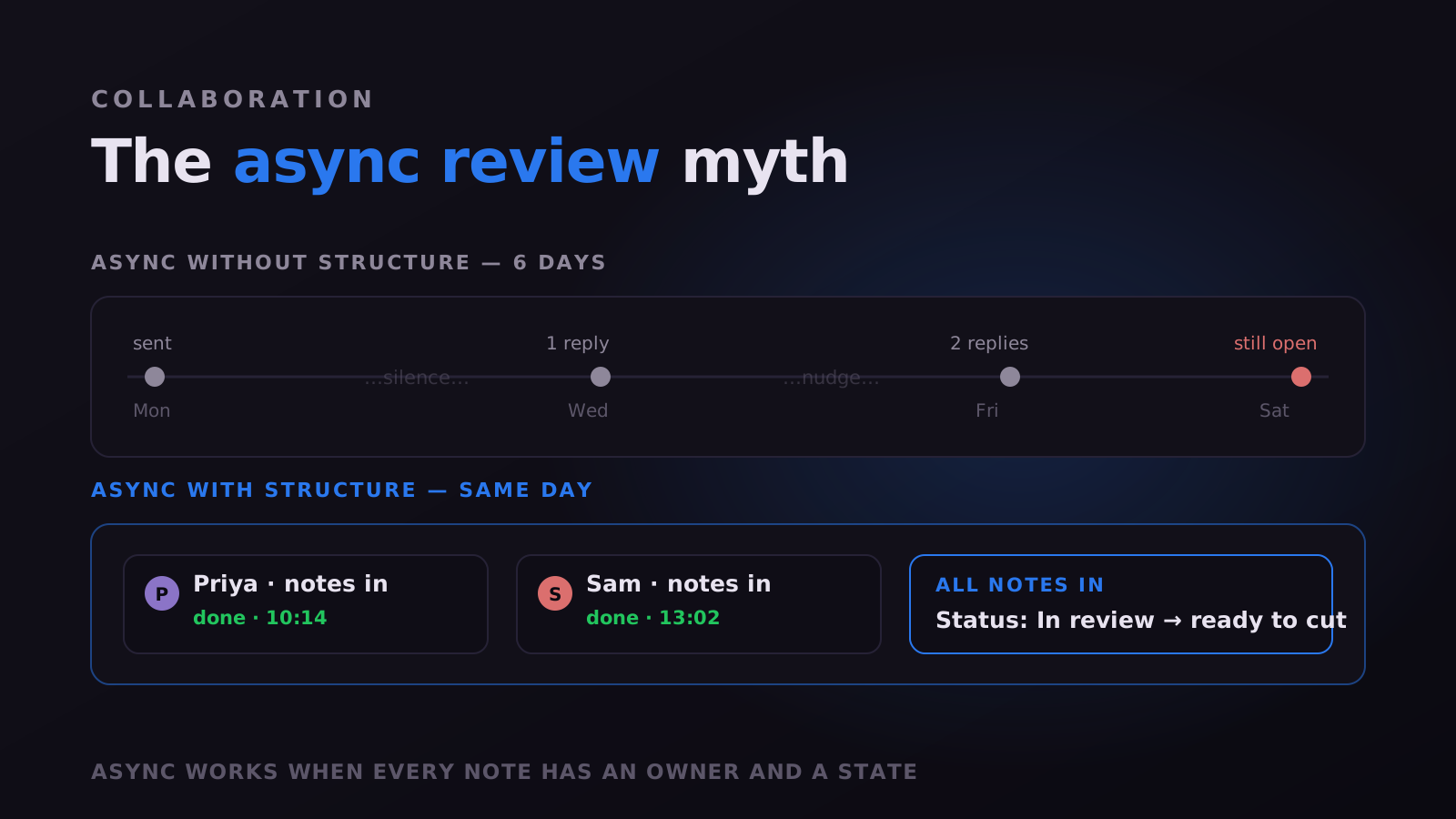
In practice, async review often feels slower. You send the cut Monday. You get one comment Tuesday, two on Thursday, a long voice memo Friday. By the time you have all the feedback, you've forgotten what you were trying to fix in the first place, and half the comments contradict each other.
Why async breaks down
Async only works when the tool aggregates feedback intelligently. If it's just a chat thread or a comments column, you still have to manually reconcile contradictions, chase missing reviewers, and decide what to act on. That's a meeting in slow motion.
- Aggregate comments by frame, not by person: see all feedback on a moment in one glance
- Surface contradictions automatically: "Reviewer A wants this longer, Reviewer B wants it cut"
- Set deadlines per draft so feedback doesn't trickle in for a week
- Auto-summarize the round so the editor sees signal, not noise
The thing the meeting was secretly doing
The review call had one property worth keeping: it forced a decision. Five people in a room disagreeing about the intro had to converge before the call ended, because the calendar said so. Async removed the meeting and, without anyone noticing, removed the forcing function too.
That is why async review often produces more feedback and less resolution. Everyone contributes an opinion; nobody is obliged to reconcile them. The editor inherits the reconciliation, which was never their job and which they lack the authority to do.
Async needs a decider, not just a deadline
- Name one person whose call settles contradictions: before the round opens, not after
- Give the round an end time, so late feedback is explicitly late rather than ambiguous
- Let reviewers see each other's notes, so duplicates and disagreements surface early
- Close the round explicitly, so the editor knows the input is complete
With those four in place, async genuinely beats the meeting: reviewers think at their own pace, notes are frame-accurate rather than remembered, and the record is written down instead of half-recalled. Without them, you have a meeting spread over five days with nobody in charge.
On your last project, how long between the first comment and the last? If it is more than 48 hours, the bottleneck is not your editor. It is that the round never had an end.
What the meeting was actually providing
Before replacing a review call it is worth being precise about what it did, because async fails whenever it drops one of these without noticing. A review meeting delivered four things, only one of which was the feedback itself.
- Shared attention. Everyone looked at the same frame at the same moment, so "the bit near the end" resolved instantly.
- Immediate disambiguation. A vague note got one clarifying question and became actionable inside ten seconds.
- A decider in the room. Conflicting opinions were resolved live by whoever outranked the disagreement.
- A hard stop. The meeting ended, and the ending was itself the decision. Async has no natural terminator.
Most async setups replace the first and forget the rest. You get comments, but ambiguity now costs a day instead of ten seconds, conflicts sit unresolved because nobody is designated, and the round never formally ends because nothing forces it to.
Replace disambiguation with precision at the source
The clarifying question was the meeting's highest-value function, and the fix is not to reintroduce it faster. It is to make the ambiguous note harder to write in the first place.
A note pinned to an exact frame cannot be about the wrong moment. One that carries a category, visual, audio, text, timing or graphics, cannot be about the wrong discipline. One marked Must Fix or Suggestion cannot be misread for urgency. Freehand drawing on the frame handles the remainder, the cases where the reviewer knows what is wrong but has no vocabulary for it.
When a note still arrives unactionable, the answer is a state rather than a meeting. Needs info sends it back with a question attached and stops it counting against the round, which is the async equivalent of turning to someone and asking what they meant.
Automatic transcripts and comment summaries are becoming standard, and they are useful. But summarising twelve imprecise comments produces a tidy summary of twelve imprecise comments. Precision has to be captured at the moment the note is written, because nothing downstream can recover what was never specified.
Give the round an ending
The missing hard stop is what makes async feel slower even when it is faster. A meeting ends. A comment thread just goes quiet, and quiet is ambiguous: it might mean approved, might mean busy, might mean waiting for someone else.
So the ending has to be an explicit action. A draft carries a visible status, Draft, Editing, In Review, Changes Requested, or Approved, and a reviewer either approves the version or requests changes. A readiness indicator shows whether every blocking note is closed, with suggestions listed separately so a good idea does not masquerade as an obstacle. When a production manager approves, that sign-off is timestamped against that specific version.
That is the piece most async workflows never install, and it is why they drift. Without a terminator, rounds bleed into each other and nobody can say which version anyone actually agreed to.
The chase, automated
The other silent tax is that following up becomes a person's job, usually yours, and therefore happens late and apologetically. Editors are notified the instant feedback lands, reviewers when a new revision is ready, and reminders surface reviews that have gone quiet without anyone deciding to nag. Each person sets their own volume, including a digest instead of live pings.
Reviewers are also always pointed at the latest version, which quietly removes one of the most expensive async failures: careful feedback delivered on a cut you replaced two days ago.
When to call the meeting anyway
Async is a default, not a religion. Three situations still justify getting people in a room, and pretending otherwise wastes more time than the call would.
- The direction is genuinely undecided. Async is excellent at converging on a known target and poor at choosing between two.
- The disagreement is between people rather than about the cut. Those resolve faster with tone of voice attached.
- It is the first cut of a new relationship, where the client has not yet learned what your notes mean or you theirs.
Everything else, which is most rounds on most projects, is a verification pass. Those are the ones async genuinely does better, provided the tool carries the ambiguity, the decision and the ending rather than leaving all three to goodwill.
What good async looks like from the outside
It is worth describing the target state concretely, because "do async properly" is not an instruction anyone can act on. Here is what a healthy round looks like when the tool is carrying its share.
- The editor uploads a cut, marks it client-ready, and writes two sentences saying what they were unsure about.
- Reviewers are notified automatically. They open a secure link, with no account to create, and comment on the frames rather than describing moments.
- Ambiguous notes come back as Needs info the same day instead of becoming a guess or a call.
- The nominated decider resolves the two conflicting notes and marks the loser Won't fix with a reason.
- The next version carries every prior note forward, and the round ends with an approval recorded against that specific cut.
No meeting appears anywhere in that sequence, and no step depends on someone remembering to chase. That is the actual test: not whether you avoided a call, but whether the round would have completed if the most organised person on the team had been on holiday.
Teams that get there describe the same shift. Async stops feeling like a slower version of the meeting and starts feeling like the meeting was an expensive workaround for a tool that could not carry context. The call was never the point. Shared attention, disambiguation, a decider and an ending were the point, and three of those four are things software does better than a calendar invite.
"If your async process needs one heroic person to keep it moving, you have not replaced the meeting. You have just made someone the meeting."
Stop reading. Start shipping.
Try Magpiie on your next draft. 30-day free trial on Creator Crew, auto-renews and cancel anytime. Bring your team in five minutes.