'/%3e%3cpath%20d='M20%200C31.0454%200.000263888%2039.9999%208.95455%2040%2020C39.9999%2030.962%2031.1805%2039.8647%2020.25%2039.999C20.2428%2039.9991%2020.2348%2039.999%2020.2275%2039.999V40C20.2173%2040%2020.2065%2039.9991%2020.1963%2039.999C20.1311%2039.9996%2020.0653%2040%2020%2040V39.9941C18.9137%2039.9663%2017.8401%2039.7415%2016.835%2039.3252C15.76%2038.8799%2014.7828%2038.227%2013.96%2037.4043C13.137%2036.5813%2012.4835%2035.6036%2012.0381%2034.5283C11.5928%2033.4531%2011.3633%2032.3005%2011.3633%2031.1367V21.1904L15%2023.29V31.1367C15%2031.823%2015.1358%2032.5026%2015.3984%2033.1367C15.6611%2033.7708%2016.0459%2034.3477%2016.5312%2034.833C17.0164%2035.3181%2017.5927%2035.7032%2018.2266%2035.9658C18.842%2036.2207%2019.5013%2036.3546%2020.167%2036.3623C20.1795%2036.3622%2020.1925%2036.3625%2020.2051%2036.3623C29.1474%2036.2525%2036.3632%2028.9687%2036.3633%2020C36.3632%2010.9629%2029.0371%203.63698%2020%203.63672C18.3456%203.63673%2016.7505%203.88277%2015.248%204.33789L11.2344%202.01953C11.3217%201.97623%2011.4102%201.93338%2011.499%201.8916C14.081%200.677617%2016.9642%201.31978e-05%2020%200Z'%20fill='url(%23paint1_linear_3622_27254)'/%3e%3ccircle%20cx='13.179'%20cy='17.2727'%20r='2.27273'%20fill='%237F6AA0'/%3e%3cdefs%3e%3clinearGradient%20id='paint0_linear_3622_27254'%20x1='32.2865'%20y1='6.36342'%20x2='-0.0294657'%20y2='36.0851'%20gradientUnits='userSpaceOnUse'%3e%3cstop%20offset='0.163105'%20stop-color='%23D76F70'/%3e%3cstop%20offset='1'%20stop-color='%237F6AA0'/%3e%3c/linearGradient%3e%3clinearGradient%20id='paint1_linear_3622_27254'%20x1='40'%20y1='0'%20x2='9.66985'%20y2='38.7763'%20gradientUnits='userSpaceOnUse'%3e%3cstop%20stop-color='%23DB6F6E'/%3e%3cstop%20offset='1'%20stop-color='%23F7BA29'/%3e%3c/linearGradient%3e%3c/defs%3e%3c/svg%3e)
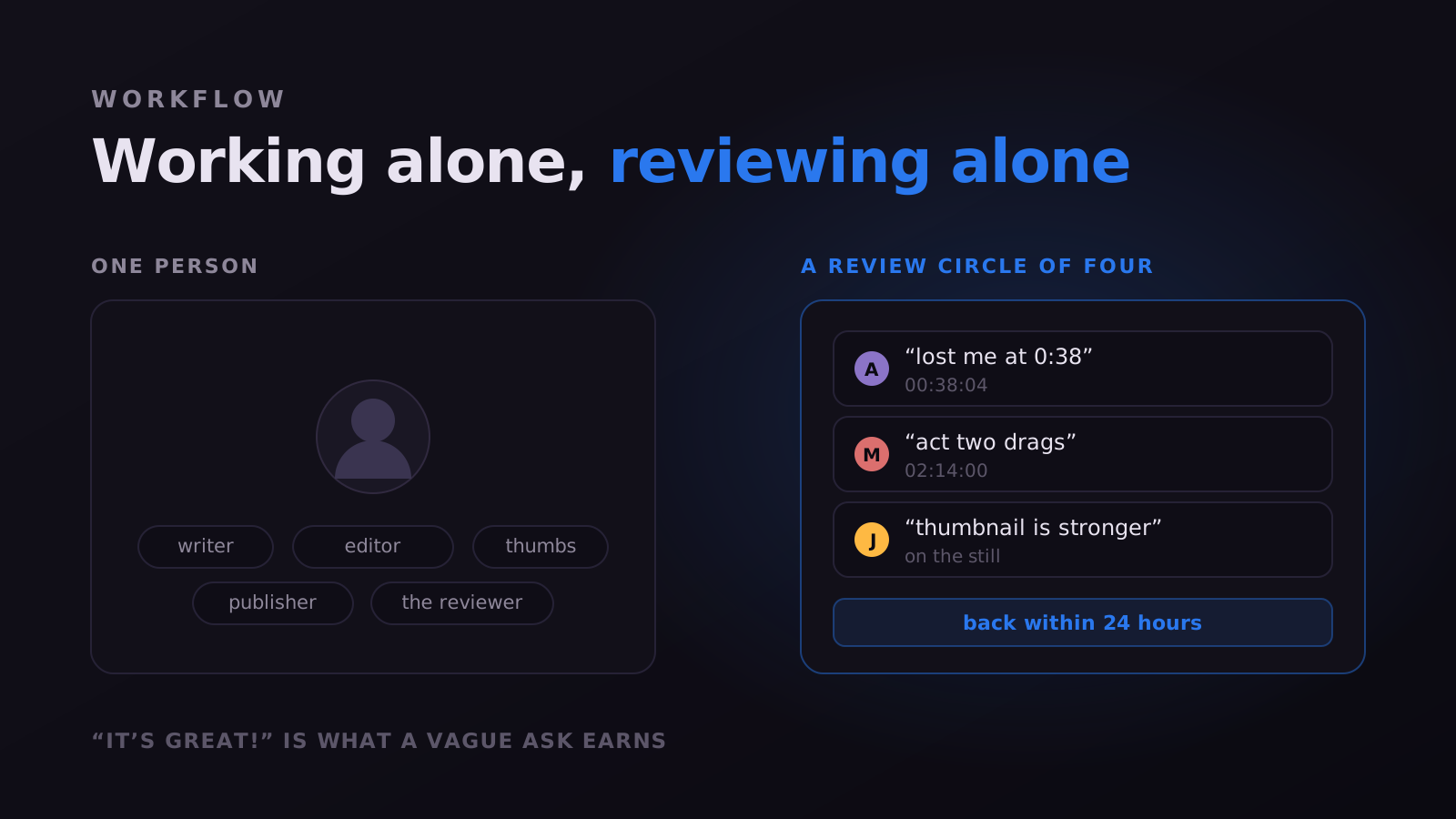
Solo creators ship alone. There's no producer to say "the second act is dragging." No editor to say "the joke at 2:14 isn't landing." No team review where five people poke at the cut and surface the things you're too close to see.
The result: a lot of solo creators publish work they secretly know isn't their best. Not because they're lazy, because the feedback loop is broken. Asking a friend to "watch this and tell me what you think" gets you "yeah it's great!" not the surgical critique you actually need.
Why "it's great!" is the default answer
Your friend is not being dishonest. They have been handed an unbounded request with no idea what kind of answer is useful, no sense of how finished the work is, and a strong social incentive not to be discouraging. Under those conditions, praise is the safe response, and they give it.
The fix is to make criticism the easier answer. A specific question: "does the first thirty seconds earn the next thirty?": gives them permission and a target. Vague asks get vague answers; that is a property of the ask, not the friend.
You are the worst judge of your own cut
After the fourth pass you are no longer watching the video. You are watching your memory of every decision that produced it, and that memory papers over exactly the gaps a first-time viewer trips on. This is why the sag in act two is invisible to you and obvious to everyone else.
Building a feedback circle without a team
Magpiie lets solo creators set up a small review circle: a handful of trusted reviewers (other creators, an editor friend, your most honest viewer) who get a link to every cut before publish. They can leave timestamped, frame-accurate notes in five minutes. You get a structured review without hiring a team.
- Invite 3–5 trusted reviewers to your circle
- Auto-share new drafts with the circle as soon as you upload
- Set a soft deadline so feedback comes back in 24 hours, not a week
- Aggregate notes by frame so contradictions surface fast
Make it reciprocal and it lasts
The circles that survive are the ones where everybody is also getting reviewed. A standing swap with three other creators costs each of you twenty minutes a week and replaces the entire function of a production team's review pass. Asking for one-directional free labour, however politely, quietly expires after a few rounds.
On your next upload, ask your circle exactly one thing: where did you lose interest? It is specific, it is answerable in one timestamp, and it surfaces the single problem most likely to cost you the audience.
Structure is what a solo creator is missing, not people
The instinct when working alone is to assume the gap is company. Usually the gap is narrower and more fixable: a team supplies structure as a side effect of existing, and solo work has to install that structure deliberately or go without it.
- A team creates a deadline by having someone waiting. Alone, nothing external ends the round, so cuts drift.
- A team creates distance, because someone who was not there when you shot it watches with fresh eyes.
- A team creates a record, because things have to be said out loud to be coordinated.
- A team creates a stopping point, because at some stage someone else says it is done.
Only the second of those genuinely requires another person. The rest are process, and process can be installed by a tool that behaves like a colleague who never forgets anything.
Reviewing your own work as if you were someone else
The practical trick is to separate making from judging, in time and in interface. Finish the cut, upload it, and stop. Come back the next morning and review it as a reviewer: click frames, leave notes, mark them Must Fix or Suggestion, and do not fix anything while you are looking.
That sounds like theatre and is not. Writing a note forces vague dissatisfaction into words, and pinning it to a frame stops you smoothing over it the way you do when the fix is one keystroke away. You end up with a list rather than a feeling, and a list can be worked through.
The version stack does quiet work here too. Because each cut is preserved with its own notes, you can watch your own decisions accumulate across V1 to V4 and notice patterns: that you always over-trim the open, that your third act tends to sag, that the notes you leave yourself about music are never actionable.
Borrowing a reviewer for eight minutes
For the one thing that does need another person, the barrier is almost never willingness. It is the size of the ask. "Can you look at my video" is unbounded and lands as a favour worth an hour. A secure review link with a specific request is a bounded task someone can do between meetings.
- Send a link, not a file. No signup, no download, and they can comment on the frame rather than writing prose.
- Name the runtime. "Eight minutes, and I only need the first ninety seconds judged" is a task; "thoughts?" is a project.
- Ask one specific question. Whether the open works is answerable. Whether the video is good is not.
- Reciprocate on a schedule rather than on demand, because a standing swap survives busy weeks and an ad hoc favour does not.
Two people trading eight-minute reviews weekly reproduces most of what a small team provides, and it costs each of them about half an hour a month. The reason it usually fails is not effort. It is that the ask was framed as a favour instead of a task.
Two members, five projects, 5 GB, with frame-accurate comments and version stacking included. It is deliberately sized for a creator and one other person: an editor, a co-founder, or the peer you swap reviews with. Client review links and Compare start on the paid plans.
The stopping problem
Ask solo creators what actually costs them the most and very few say loneliness. They say they cannot tell when something is finished. Without anyone to say it is done, the cut stays open, and an open cut attracts changes indefinitely.
This is where a readiness signal earns its place even on a team of one. A draft either has open blocking notes or it does not, with suggestions listed separately so a passing idea never masquerades as an obstacle. When nothing is blocking, the thing is publishable, and that is a fact about the list rather than a mood you are in at eleven at night.
- Write the notes first, in one pass, before fixing anything. Mixing judging and making is what turns an hour into an evening.
- Mark each one Must Fix or Suggestion honestly. Most creators discover their blocker list is a third the size they assumed.
- Clear the Must Fix list, then stop. Suggestions go to the next video, where they cost nothing.
- Record the approval anyway, even though it is only you. It is the difference between shipping and abandoning.
That last one sounds absurd until you try it. Marking your own version approved is a small ceremony that closes the loop, and it leaves a record of what you thought was finished, which is exactly the context you will want when the same project comes back in a month.
"A solo creator does not need a team. They need the three things a team accidentally provides: a deadline, a record, and someone to say it is done."
Common questions
Is a review tool overkill for one person? It is overkill if you use it as a filing cabinet. It earns its place the moment you start treating your own second pass as a review rather than more editing, because that is the habit that separates work you finish from work you keep fiddling with.
What if I have nobody to swap reviews with? Start with an audience of one that is not you: a friend who watches the kind of thing you make, a former colleague, someone from a community in your niche. The ask is eight minutes and a link, not a mentorship. Most people say yes to the first and no to the second.
Does the free plan cover a solo creator properly? Two members, five projects, 5 GB, three versions per project, with frame-accurate comments and version stacking. That covers a creator plus one editor or one regular reviewer indefinitely. What you give up is client review links, downloadable drafts and Compare, which start on Creator Crew.
Will this make me slower? For the first two projects, slightly. Writing notes before fixing feels like ceremony until the week you pick up a project you have not touched in a month and the list tells you exactly where you were.
Stop reading. Start shipping.
Try Magpiie on your next draft. 30-day free trial on Creator Crew, auto-renews and cancel anytime. Bring your team in five minutes.